Middle East Buffet Equipment Guide: How Hotels and Importers Select, Specify and Source
Sep 29,2026
For hotels and importers across the Middle East, buffet equipment sourcing is a solution decision, not a catalog exercise. Demand for middle east buffet equipment centers on two selection priorities: dependable hot-food holding performance in demanding service conditions, and material specifications supported by proper documentation for local food-contact standards. This guide breaks down selection factors, compliance, logistics, Ramadan planning and cost structure for the middle east market, so every quotation can be compared specification-to-specification. Project-level support, including middle east buffet equipment solutions built to project requirements, is available through PYEIN's Middle East Market Solution team.
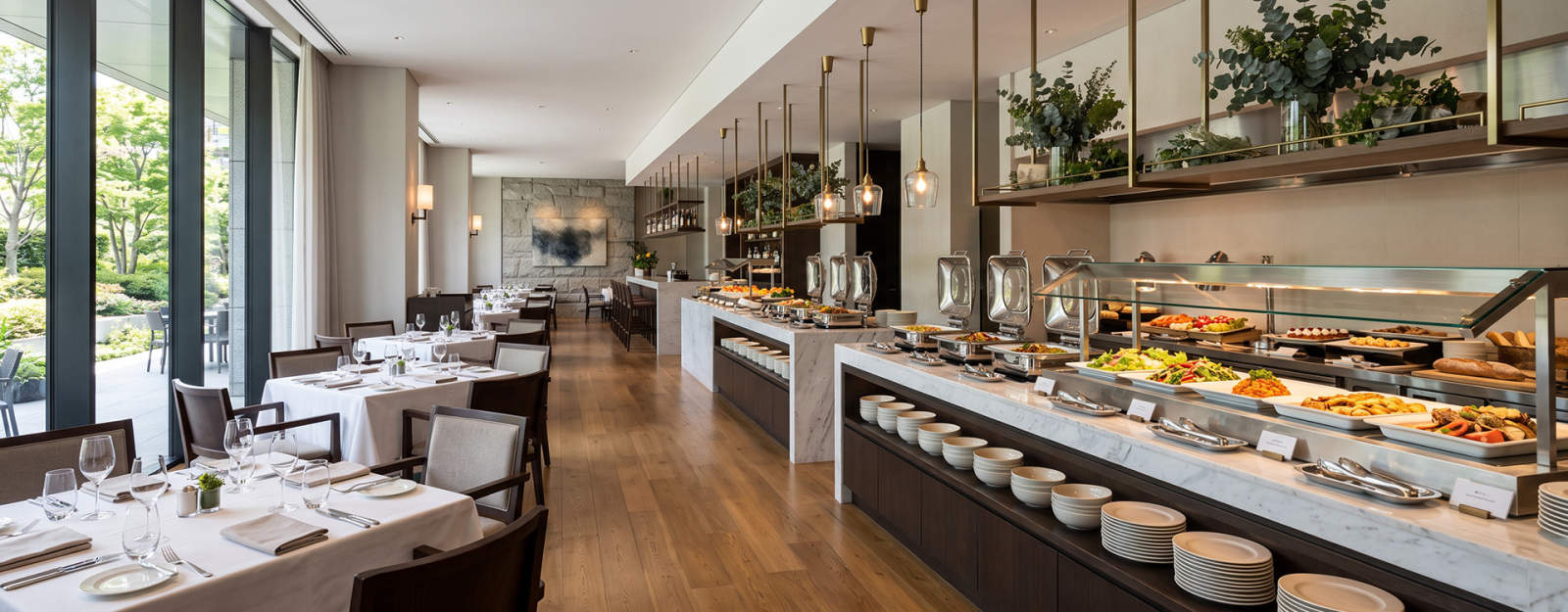
A well-planned hotel buffet combines presentation, guest circulation and service efficiency in one layout.
Middle East Market: Where Buffet Equipment Demand Comes From
The Middle East is not a single hospitality market. Saudi Arabia, the United Arab Emirates, Qatar, Oman, Kuwait, Bahrain, Egypt and Jordan each have different hotel environments, project scales and regulatory frameworks, with the GCC markets forming the region's commercial core.
Market Indicator
Q2 2026
Hotel projects in pipeline
724
Rooms in pipeline
178,003
Year-over-year growth
+11%
According to Lodging Econometrics, the regional pipeline grew 11% year over year, and a large share of these projects is still in planning or early construction — which means buffet equipment decisions are being made now, long before hotel openings. Requirements differ by project stage:
Practical conclusion: source middle east buffet equipment starting from the project application and buffet layout, not by picking products from a catalog. The layout defines the equipment schedule; the schedule defines the quotation.
Buffet Equipment for Hotels: Materials, Specifications and Capacity
A supplier can only recommend the right equipment when five basic requirements are reasonably clear: application, capacity, material and finish, technical specifications, and delivery terms. For buffet equipment for GCC hotels, those five requirements are what turn a project wish list into a workable specification. Different applications require genuinely different combinations:
Application
Typical Equipment
Key Considerations
Hotel Breakfast
Chafing dishes, buffet displays, cereal and beverage stations
High frequency, replenishment, cleaning
Banquet
Buffet tables, heated displays, display stands
Fast setup and breakdown
Ramadan / Iftar
Hot food equipment, dessert stands, date displays, beverage stations
High-volume service and presentation
Seafood Buffet
Cold displays, trays, ice presentation
Hygiene and corrosion resistance
Fine Dining Buffet
Premium display stands, custom counters
Finish, proportion, design consistency
Catering
Portable and modular equipment
Transport, repeated use, durability
Materials: What to Verify Before You Believe "Stainless Steel"
Material specification should be documented, not assumed. Saudi Arabia's SFDA technical guidance states that food-contact equipment surfaces should be made from stainless steel or non-toxic materials suitable for food use, easy to clean and resistant to corrosion, able to withstand repeated washing and disinfection, and free from pits, cracks and peeling. Rather than asking only "Is this stainless steel?", professional buyers confirm the material grade, which components are food-contact surfaces, the surface finish, how welded areas are finished, whether edges are rounded and easy to clean, and what documentation is available for the destination market.
Food-contact surfaces, welds and edges are where material quality becomes visible in daily operation.
Capacity: Think in Systems, Not Individual Products
The correct dimensions depend on buffet counter sizes, guest capacity, number of lines, food pan sizes, replenishment frequency, staff access, storage and guest circulation. Instead of asking "How many chafing dishes do we need?", a project buyer should ask: "How many guests will this buffet serve at peak, how many food categories are offered, and how quickly can staff replenish each station?" For a gulf hotel banquet equipment package, this approach turns the buffet layout into a workable equipment schedule rather than a guess. A 300-cover ballroom banquet in Riyadh, a resort iftar in Dubai and a business-hotel breakfast in Doha may share the same equipment categories, but rarely the same quantities — service style and replenishment staffing decide the final counts. Electrical items such as induction units, heat lamps and heated display counters additionally require confirmed voltage + frequency + wattage + plug configuration + applicable documentation for the destination market.
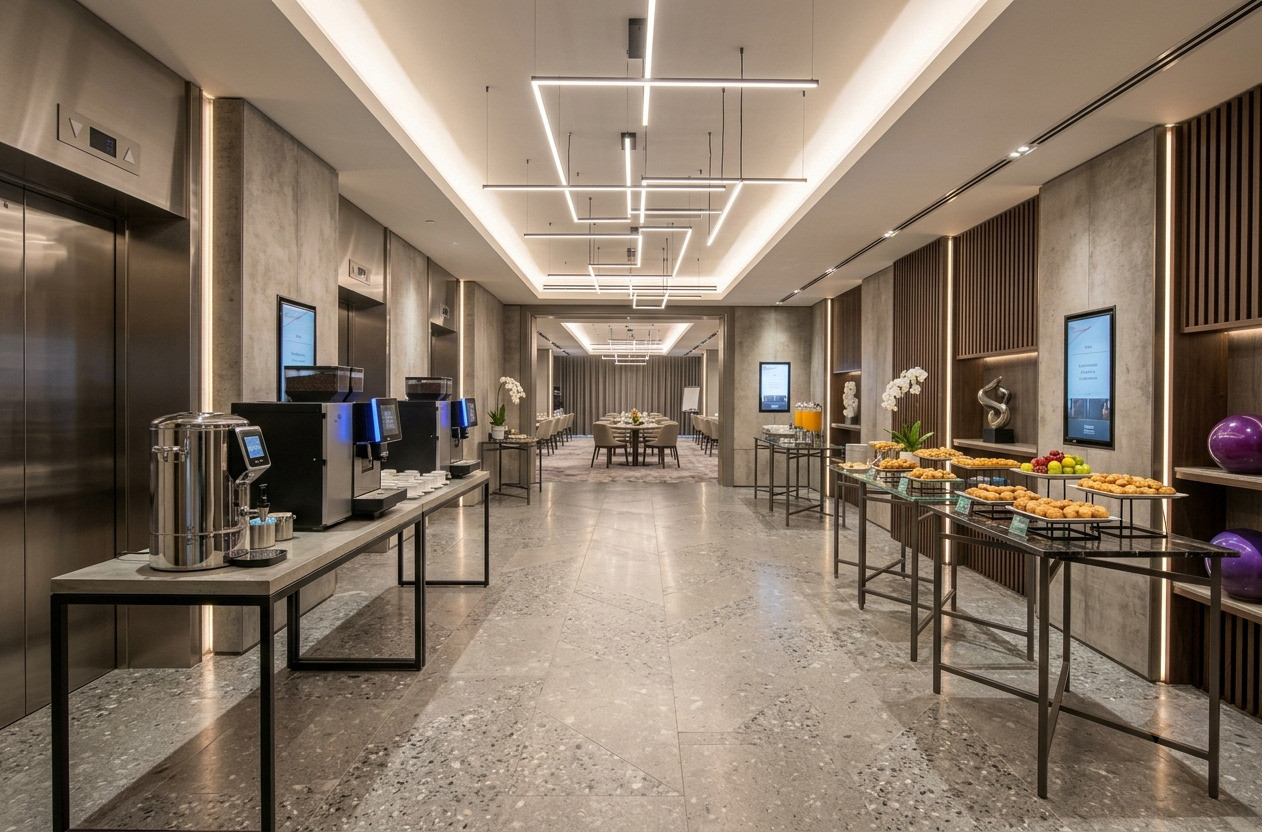
Hotel applications range from daily breakfast service to banquet and seasonal Ramadan operations.
Middle East Hotel Buffet Compliance
There is no single document that proves every buffet product is compliant across every Middle East market. The GCC Standardization Organization maintains Gulf technical regulations, including GSO 21:2021 covering hygienic requirements for food plants, personnel, and materials and articles in contact with foodstuffs. Individual countries can add their own requirements — Saudi Arabia's SFDA, for example, publishes food hygiene requirements and technical guidance for food-contact equipment surfaces. Consolidating these requirements before production begins, as part of a documented middle east hotel buffet compliance review, prevents specification changes once manufacturing has started.
Ten points are worth confirming in writing before the order is placed:
Area
What to Confirm
Material
Grade and intended application
Food-contact surface
Suitable, smooth and cleanable
Corrosion resistance
Appropriate for the intended use
Welding
Smooth and properly finished
Edges
No unnecessary sharp edges
Electrical products
Voltage, frequency and applicable requirements
Documentation
Test reports or declarations where applicable
Product specification
Dimensions, capacity and power
Packaging
Suitable for international transportation
Destination market
Country-specific requirements
Matching common specifications to applications and usage frequency helps buyers size the order correctly:
Common Specification
Typical Application
Usage Frequency
Full-size rectangular chafing dish, GN 1/1 pans
Hotel breakfast and banquet hot-food lines
Daily, multiple services
Round / induction chafing dishes
Fine-dining buffets, Ramadan iftar
Daily and seasonal peaks
Heat lamps, 2–3 lamp units
Carving stations, action counters
Daily service peaks
Beverage dispensers and juice stations
Breakfast and iftar beverage lines
Daily, high turnover
Dessert and cake display stands
Buffet dessert zones, Arabic sweets
Daily and seasonal
A better procurement question: instead of "Is this product GCC certified?", ask "Which technical requirements and supporting documents apply to this product in my destination market?" This creates a far more accurate purchasing process.
Gulf Market Buffet Equipment Logistics
For international buyers, the product is only one part of the supply chain. Gulf market buffet equipment logistics is where delivery schedules are made or lost — a typical project moves through a fixed sequence, and every stage can affect the final schedule:
Requirement → Product selection → Quotation → Sample and design confirmation → Production → Inspection → Packaging → Container loading → International shipping → Customs and local delivery → Hotel project
Engineering Inputs That Should Be Confirmed Before Quotation
A buffet equipment quotation sits downstream of a small set of project engineering inputs. Where these are not confirmed early, specifications get revised after production has already started:
Commercial kitchen engineering survey — site services, space and access conditions the buffet line has to work within.
Buffet line engineering drawings — counter dimensions, equipment positions and connection points agreed before production begins.
Hotel kitchen utility capacity check — power, water and ventilation capacity available at each point of use.
Buffet line electrical load schedule — voltage, frequency and wattage item by item, so the installation matches the destination market.
Kitchen equipment installation sequence — the order in which units are delivered, positioned and commissioned on site.
These engineering inputs are reviewed with project buyers as part of PYEIN's Engineering Solutions work, alongside product supply.
What the Purchase Specification Should Define
Product code
Quantity
Dimensions
Material
Finish
Color
Logo
Electrical specification
Packaging
Carton dimensions
Gross weight
Net weight
Production lead time
Inspection requirements
Shipping terms
For larger projects, the product schedule should also be linked to the buffet layout and the BOQ, so quantity, specification and delivery terms stay consistent across the whole package.
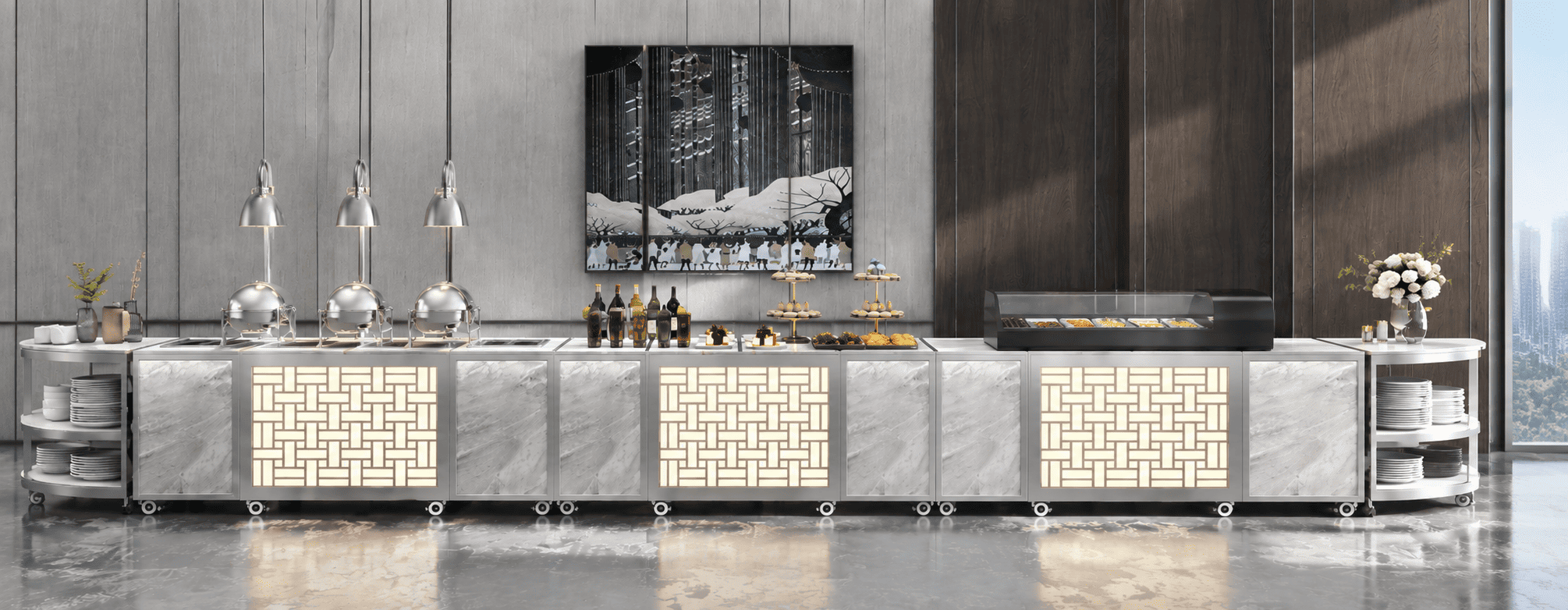
Custom counters and stainless equipment are produced to confirmed specification, then export-packed for international transit.
Ramadan Buffet Equipment Planning: A Pitfall-Avoidance Checklist
Across Saudi Arabia, the UAE, Qatar and other Middle Eastern markets, ramadan buffet equipment planning follows specific requirements — equipment quantities should not be based on the assumption that every Ramadan buffet needs the same package. Actual requirements depend on hotel category, guest capacity, iftar service volume, number of buffet lines, food categories and expected peak demand. A practical iftar layout works through four equipment zones:
Material grade confirmation plus test reports or declarations applicable to the destination market
Packaging and container loading
Export cartons, foam or wooden case protection, loading plan and packing photos before shipment
Design the Buffet Around Guest Flow
A Ramadan buffet should not simply contain more equipment — it should provide a logical guest journey. On the guest side: approach, browse, select, serve, move. On the service side: storage, replenishment, cleaning, rotation. If these two flows conflict, the buffet becomes crowded even when enough equipment has been purchased. Effective planning considers the complete space + equipment + food flow, not just the number of products.
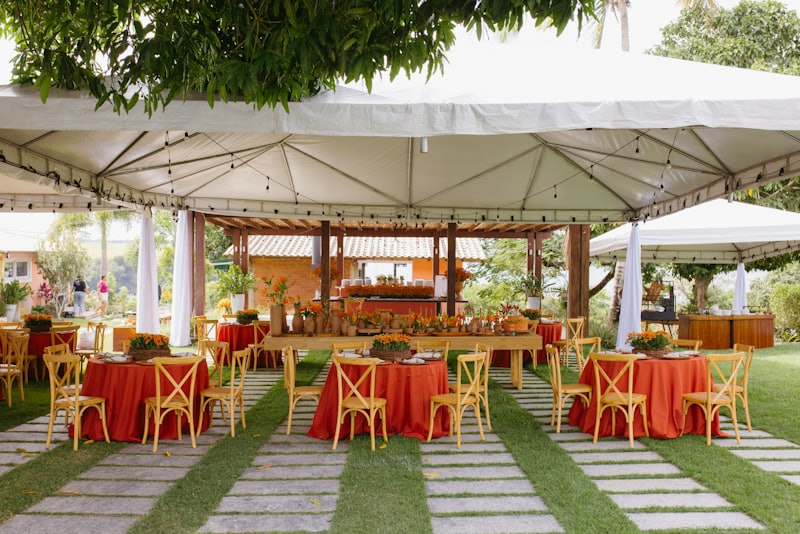
Ramadan service environments — outdoor iftar venues and hotel banquet lines alike — drive zone-based equipment planning.
Cost Structure: Where the Price Difference Really Comes From
There is no meaningful single average price for middle east buffet equipment. A quotation is built from five cost blocks:
Cost Block
Main Variables
Impact on Quotation
Material
Stainless grade, thickness, quantity
Single largest block; grade and panel thickness move unit cost directly
Labor
Cutting, forming, welding, assembly
More complex structures require more forming and welding hours
Polishing and finish
Brushing, polishing, plating or coating
Uniform premium finish adds process steps and quality control
Packaging
Carton, foam, wooden case, custom protection
Export-grade protection costs more but reduces transit damage
Logistics
Volume, weight, destination, shipping terms
Chafing dishes ship by volume; stacking design affects container loading
Two suppliers can quote visually similar buffet equipment and still be selling two different products. This is why a unit price alone rarely tells you which quotation is better value:
Quotation A — Standard Supply
Quotation B — Project-Grade Supply
Standard dimensions
Customized dimensions
Standard finish
Premium finish with documented process
Basic packaging
Export packaging with protection for mixed materials
No sample stage
Physical prototype or sample approved before production
Limited customization
Customized branding and configurations
Self-declared quality
Inspection with packing and product photos
The unit prices may differ significantly without representing the same product. The correct comparison is specification-to-specification, not price-to-price.
Factory Direct vs. Trading Company: Price and Lead Time
Factor
Factory Direct
Trading Company
Price level
Factory-gate pricing without an intermediate margin layer
Includes a trading margin on top of the factory price
Lead time
Production schedule directly trackable at the factory
Depends on third-party factory scheduling plus a coordination layer
Customization
Discussed directly with the manufacturer
Depends on the factory network
Quality control
Direct factory coordination
Depends on arrangement
Product range
Manufacturer's own range
Potentially broader
Sourcing flexibility
Manufacturer-specific
Can source across suppliers
Neither model automatically suits every buyer. Importers with an established product portfolio may value trading-company flexibility, while buyers requiring custom buffet equipment, product development, private label or project-specific specifications benefit from direct manufacturer communication.
Key Specification: Choosing Between 201, 304 and 316 Stainless Steel
Option
Characteristics
Suitable For
201 stainless steel
Cost-optimized option with lower corrosion resistance
Less corrosive, dry indoor applications on tighter budgets
304 stainless steel
Widely used for food-contact components; resists rust best in daily service
Chafing dishes, display stands and most food-contact components, with compliance confirmed per product and use
316 stainless steel
Enhanced resistance to chlorides and salt exposure, premium tier
Coastal properties, seafood stations and high-salt environments
PYEIN manufactures both 304 and 201 stainless steel. 304 is widely used for items that touch food and is the grade we recommend for most applications; 201 is available as a cost-optimized option. Compliance for any specific product is confirmed by the product itself, its intended use and the supporting documentation — grades are confirmed per piece against your budget, menu and service environment when you request a quote. Browse the chafing dishes range to match grades and finishes to your project.
How to Compare Buffet Equipment Suppliers
For B2B buyers, supplier comparison matters as much as product comparison. Before awarding an order, check whether the supplier can demonstrate each of the following — ideally against one of your real projects:
Dimension, material, finish, color and logo changes quoted directly from drawings
Sample capability
Physical sample or prototype approval before mass production
Quality control
Material confirmation, in-production and final inspection, packing and product photos
Documentation
Test reports and declarations matched to the destination market
Export packaging
Export cartons, foam or wooden cases plus a documented loading plan
Lead time
Production schedule broken down by item, quantity and customization level
Project support
Works from BOQs, product schedules, buffet layouts, 3D designs and quantity lists
The last row is often the deciding one. PYEIN project support starts from your actual project documents — BOQ breakdowns, buffet layouts, 3D concepts and sample planning — so the comparison runs on your specification, not on a catalog page.
How PYEIN Supports Middle East Buffet Equipment Projects
PYEIN approaches Middle East hospitality projects through product selection, application matching, customization and manufacturing support. The objective is not to sell individual products, but to help buyers build a suitable equipment package for the intended hospitality environment.
01
Understand the Project
Project country, hotel or venue type, buffet application, guest capacity, buffet layout, required quantity, design style, preferred finish and delivery schedule. Where they exist, buffet line drawings, a utility capacity check or an electrical load schedule are reviewed at the same stage.
02
Match Products to the Application
Products are evaluated against function, space, capacity, design and budget rather than matched from a catalog page.
03
Confirm Specifications
Dimensions, materials, finish, color, logo, heating or cooling requirements, electrical specifications, packaging and documentation.
04
Sample or Prototype
For customized projects, sampling confirms proportion, finish, color, construction, branding and function before mass production.
05
Production and Inspection
Mass production follows the approved specification, with material confirmation and pre-shipment checks against the agreed requirements.
What are the MOQ, lead time and sample policies for middle east buffet equipment?
MOQ, lead time and sample arrangements vary by product, customization level and manufacturing process. Standard products carry lower MOQ than customized or private-label items; a complete gulf hotel banquet equipment package — whether the project is in Saudi Arabia, the UAE or Qatar — is quoted item by item against your BOQ or product schedule. Lead time is confirmed as a production schedule based on actual quantity and customization, physical samples or prototypes can be arranged for customized projects before mass production, and PYEIN project support provides the BOQ breakdown and sample plan behind these commitments.
How does PYEIN provide NSF / FDA compliance documentation for the middle east market?
304 is widely used for food-contact components in hotel buffet equipment, while 201 serves as a cost-optimized option for less corrosive applications. Compliance is not proven by grade alone: it is confirmed by the specific product, its intended use and the documentation provided for the destination market — such as Saudi SFDA guidance or UAE federal requirements. PYEIN supplies material confirmations, test reports and declarations against your confirmed specification and project requirements.