How Many Heat Lamps Does a Buffet Need? Placement, Wattage and Holding Times for Catering
Heat lamps for food hold a buffet line at their best when you run one lamp for every 600–900 mm of hot-food line, mounted 300–450 mm above the food at 250 W per lamp. A standard 3 m line therefore runs 4 lamps, and a 100-guest buffet typically needs 12–20 lamps across 3–4 lines. This guide gives you the placement math, the wattage decision matrix and realistic holding times — the numbers catering teams actually use on site.
Heat Lamps for Food: The Three Numbers That Decide Your Layout
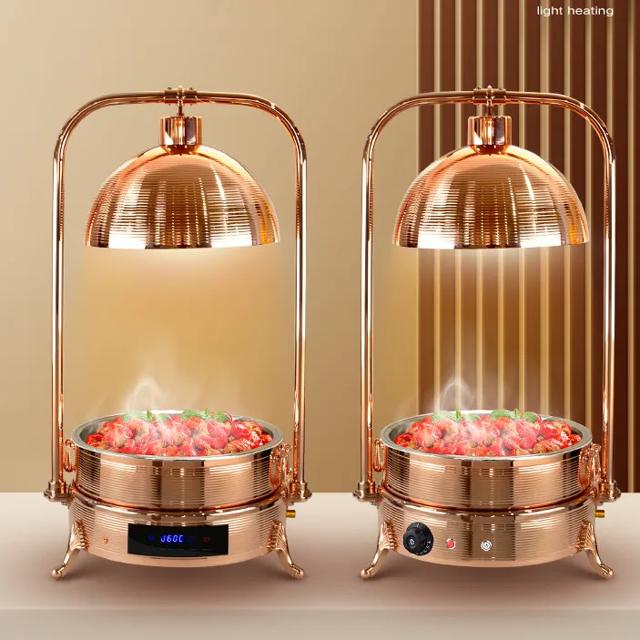
Heat lamps for food are governed by three numbers: one lamp per 600–900 mm of serving line, a mounting height of 300–450 mm between the lampshade rim and the food surface, and 250 W as the standard commercial wattage (375 W for large platters or cool rooms). Treat these as the starting point of your layout — dish height, ambient temperature and airflow will each push the final number up or down.
How Many Heat Lamps for Catering Do You Need per Buffet Line?
For most catering lines, 3 lamps cover a 2 m hot-food line, 4 lamps a 3 m line, 5–6 lamps a 4 m line, and 8 lamps a 6 m line, keeping about 200 mm of clear space at each end of the line. The rule of thumb assumes standard GN pans of roughly 60–100 mm food height; taller displays and wind-exposed rooms move you toward the denser end. The table below is the quick version your setup crew can work from.
| Hot-food line length | Lamps needed | Spacing between lamp centres | Typical total load (250 W) |
|---|---|---|---|
| 2 m | 3 | ~800 mm | 750 W |
| 3 m | 4 | ~860 mm | 1,000 W |
| 4 m | 5–6 | ~720–860 mm | 1,250–1,500 W |
| 6 m | 8 | ~800 mm | 2,000 W |
Three exceptions break the per-metre rule — count by dish, not by metre:
- Carving and omelette stations: one dedicated lamp per station regardless of line length, positioned over the action area.
- Soup and sauce points: these belong on water-bath equipment rather than open lamps; see the holding-time section below.
- Large sharing platters (whole roasts, whole fish): one 375 W lamp per platter, because the food mass needs sustained top heat.
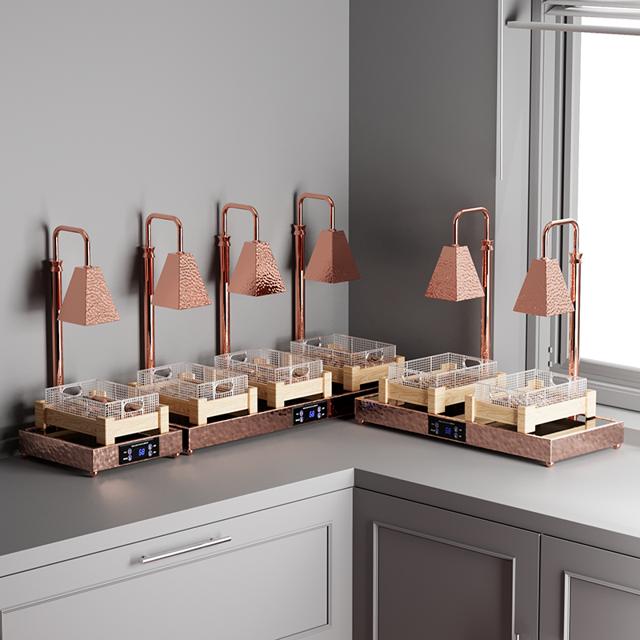
Worked example — a 100-guest hotel brunch: two 3 m hot-food lines (4 lamps each), one 2 m fried-food line (3 lamps) and one carving station (1 lamp) = 12 lamps. Add two spare heads and the total connected load is about 3.5 kW at 250 W units — comfortably within a single 16 A circuit. If you prefer fewer cables on the floor, a multi-head food warming station with dual control replaces several single-arm lamps on one base and lets you switch zones independently.
Mounting Height and Angle: Getting Heat Lamps for Food to Hold 60°C
The target under every lamp is 60°C (140°F) at the core of the food — the HACCP hot-holding benchmark — not the air temperature under the shade. A probe into the centre of the densest pan is the only honest reading; the air 100 mm below the shade can read 20–30°C higher than the food itself. Keep lamps mounted 300–450 mm above the food surface and check core temperature every service, because pan depth changes the answer more than the lamp does.
| Mounting height (shade rim to food) | Approx. heated spot diameter | Surface intensity | Best for |
|---|---|---|---|
| 300 mm | ~400 mm | High | Fried food, carving stations, fast turnover |
| 375 mm (mid-point) | ~500 mm | Medium | Standard GN pans, mixed lines |
| 450 mm | ~600 mm | Lower | Delicate pastries, long slow holding |
Spot diameters are industry rule-of-thumb values for 250 W infrared lamps — calibrate on site with a surface thermometer.
Angle matters as much as height. Keep the lamp face parallel to the food surface: a tilted lamp throws its hotspot to one side, leaving one edge of the pan at temperature and the other cooling, and the overheated edge dries and skins first. On multi-head bases, aim each head straight down rather than angled inward, and let overlap between adjacent spots do the evening-out.
250W vs 375W vs 500W: Choosing Commercial Food Heat Lamps
Choose 250 W for standard pans in normal room conditions, 375 W for tall or dense dishes, carving stations and cool or drafty rooms, and 500 W only for high-volume lines or outdoor service. Higher wattage does not simply mean warmer food — it shortens the safe distance and increases the risk of drying the surface, so the correct move is usually one wattage step up plus a height adjustment, never a jump to maximum power. Most commercial food heat lamps in hotel service are 250 W units for exactly this reason.
| Food height × environment | Cool room / draft (under 18°C, airflow) | Normal room (18–25°C) | Warm, enclosed (above 25°C) |
|---|---|---|---|
| Low profile (60 mm or less: fried items, pastries) | 375 W at 350 mm | 250 W at 350 mm | 250 W at 400 mm |
| Standard GN pan (60–100 mm) | 375 W at 400 mm | 250 W at 400 mm | 250 W at 450 mm |
| Tall / dense (roasts, whole birds, over 100 mm) | 500 W at 450 mm | 375 W at 400 mm | 375 W at 450 mm |
Two buying notes worth checking before you order. First, if your venue runs on 220–240 V while your export market or event site supplies 110–120 V, the same lamp is not automatically interchangeable — OEM/ODM manufacturing services can match voltage, plug type and cable length to your market. Second, do not confuse LED warming lights with infrared lamps: LED units emit visible light with little radiant heat and are meant for display accent, not holding temperature. If you want the full lamp-type selection framework rather than the installation side, the earlier buffet heat lamp buying guide: types, wattage and holding temperatures covers it in depth — this guide deliberately focuses on what happens after the lamps arrive on site.
Bulb Types: Infrared, Halogen and Carbon Fibre Compared
Infrared bulbs win on heat efficiency and lifespan, halogen wins on colour rendering, and carbon fibre wins on warm-up speed — so front-of-house stations should prioritise colour and back-of-house should prioritise efficiency. The practical difference shows up at carving stations, where guests eat with their eyes first, and in the back corridor, where bulbs are on for six hours straight.
| Bulb type | Heat efficiency | Colour rendering | Lifespan (typical) | Fragility | Best placement |
|---|---|---|---|---|---|
| Infrared (hard glass) | High | Medium | ~5,000 h | Moderate | Back-of-house lines, high-duty cycles |
| Halogen | Medium | High | ~2,000–3,000 h | Higher — needs guard | Carving and display stations |
| Carbon fibre | High | Medium | ~5,000 h+ | Moderate | Fast-turnover service, frequent on/off |
How Far Should a Heat Lamp Be From the Food?
Keep a heat lamp 300–450 mm from the food surface. Below 250 mm the radiant intensity is high enough to bake and discolour the top layer of most dishes within an hour; above 500 mm the heat spreads out and the food drifts below the 60°C holding line. The quick self-check: probe the centre of the densest pan 10 minutes after loading, then again every 10 minutes through the first service — if the core climbs above 75°C you are too close, if it slips below 60°C you are too far or the lamp is undersized.
Holding Times by Food Type: What Heat Lamps for Catering Can and Cannot Do
Under a correctly set lamp, most hot foods hold acceptable quality for 1–2 hours, and nothing should ride past the 2-hour (no temperature control) or 4-hour (hot-held at 60°C and above) service windows used in food-safety practice. The critical point for caterers: a heat lamp is a holding device, not a heating device — it maintains temperature, it does not recover food that has already cooled. Load pans hot from the kitchen, never warm them under the lamp.
| Food type | Acceptable holding time under lamp | Quality notes |
|---|---|---|
| Fried items (fries, spring rolls, schnitzel) | 30–45 min | Crispness fades fastest; use shallow batches, no lids, highest turnover |
| Roasted meats (sliced or whole) | 1.5–2 h | Baste or cover loosely; slice to order where possible |
| Braised dishes and stews | 2–3 h | Most forgiving; stir and re-portion regularly |
| Soups and sauces | Not lamp-suited | Hold in water-bath or soup station — see stainless steel soup pots |
| Bread, pastries, dim sum | 45–90 min | Use the 450 mm setting; skins form quickly close to the lamp |
| Fish and seafood | 30–60 min | Shortest window of any category; small batches, frequent replenishment |
The two service windows matter for planning, not just compliance. For a 2-hour brunch slot you can hold almost everything under lamps with one mid-service replenishment. For a 4-hour Sunday service, build the menu around dishes from the forgiving rows and schedule fried and seafood items in 45-minute waves from the kitchen.
Outdoor Events: Food Warming Lights Under Tents and Wind
Outdoor food warming lights lose heat much faster than indoor installations — as a rule of thumb, every 1 m/s of airflow measurably increases heat loss from the food surface, so a tent doorway draft can undo a lamp's entire output. The countermeasures are always the same trio: hang lower (toward the 300 mm end of the range, never below 250 mm), add windbreaks on the windward side, and step up one wattage tier. Never compensate by dropping the lamp so close that it scorches the food.
- Electrical safety: run lamps on a dedicated circuit, use weather-rated (IP44 or better) connectors outdoors, and route cables off walkways with covers.
- Stability: weight or clamp every stand; tent flooring plus evening wind is the classic tip-over scenario.
- Positioning: lamps crosswind of the serving line, not downwind of the tent opening.
For garden weddings and off-site banquets, a wheeled custom mobile buffet station with integrated warming solves most of the cable and stability problems at once, since the station arrives pre-wired and level.
Can You Use Food Lamps Outdoors in Winter?
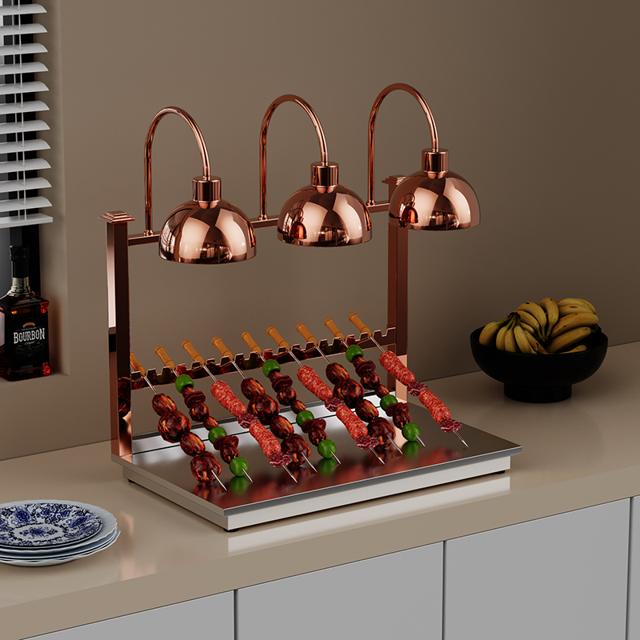
Yes — you can use food lamps outdoors in winter, with three adjustments: move up one wattage tier (250 W to 375 W), shorten the replenishment interval to 20–30 minutes so pans arrive hot more often, and fit windbreaks on the windward side of the line. Below roughly 5°C ambient, open lamps alone struggle to hold 60°C on anything but dense braised dishes, so plan the winter menu around the forgiving food types or add covered chafing units to the line.
Energy Cost of Food Warming Lights per Service
Lamp electricity is cheap: energy (kWh) = number of lamps × wattage × service hours ÷ 1,000. Six 250 W lamps running a 4-hour service consume 6 kWh — at a typical commercial rate of $0.10–0.20 per kWh that is roughly $0.60–1.20 per service. Heat lamp power is a rounding error in catering costs; labour and food waste are not, which is why the running decision below matters more than the electricity bill.
| Setup | Load | 4-hour service energy | Approx. cost at $0.15/kWh |
|---|---|---|---|
| 6 × 250 W | 1.5 kW | 6 kWh | ~$0.90 |
| 8 × 250 W | 2.0 kW | 8 kWh | ~$1.20 |
| 8 × 375 W | 3.0 kW | 12 kWh | ~$1.80 |
The real trade-off is more lamps versus more kitchen trips. Running one or two extra lamps costs cents per service and lets you display shallower batches that hold better quality; sending staff to replenish more often costs labour and risks serving a cooled pan. For anything beyond a small café, the extra lamp is almost always the cheaper half of that trade.
Placement Checklist: Heat Lamps for Catering in Hotel and Restaurant Buffets
Run this 10-point checklist before every service — it takes five minutes and catches the faults that reviews and temperature logs punish later. Pair it with the matching custom food warmer buffet ware on the line so pans, lids and lamps are specified as one system rather than mixed ad hoc.
- Height: shade rim 300–450 mm above food surface, verified with a tape, not by eye.
- Spacing: lamp centres 600–900 mm apart along the line; 200 mm clear at each end.
- Spot overlap: adjacent heated spots just touch — no cold gaps, no double-hot zones.
- Traffic clearance: lamps sit above guest reach and outside tray paths; no head-height fixtures over aisles.
- Probe points: one designated probe thermometer per line; core readings logged every 30 minutes.
- Spare lamps: at least 10% spare heads and bulbs staged within reach of the line.
- Cleanability: shades and guards wipeable without dismantling; no grease film on the bulb face at open.
- Cables: routed off the floor, no daisy-chained extension leads, dedicated circuit confirmed.
- Tip-over safety: stands weighted or clamped, especially on mobile stations and outdoor floors.
- Signage: hot-surface labels visible to staff and guests on every stand.
Heat Lamps for Food FAQ
Are food lamps safe for carving and omelette stations?
Yes — food lamps are safe for carving and omelette stations provided you mount them at about 400 mm and fit shatter-resistant covers. Open-cooking stations need higher colour rendering and splash protection, so choose halogen or high-CRI infrared bulbs with a wire guard, and keep a fire blanket within reach of the station.
Do heat lamps dry out food — and how do you prevent it?
Yes, heat lamps can dry out food, mainly when the lamp sits closer than 300 mm or the dish is displayed for too long. Prevent it by holding the 350–450 mm distance, using lids or regular basting, and shortening display time — replenish smaller batches more often instead of parking one large tray under the lamp for hours.
Heat lamp vs chafing dish: which holds temperature better?
A chafing dish holds temperature more steadily because the water bath surrounds the pan on all sides, while a heat lamp heats only the exposed top surface. Heat lamps for food win where presentation and high-frequency self-service matter; most professional lines use both — chafing dishes for wet dishes and soups, heat lamps for plated items, fried food and carving stations.
How many heat lamps for 100 guests?
For 100 guests, plan roughly 12–20 heat lamps in total: usually 3–4 hot-food lines with 4–6 lamps per line, plus about 10% spare lamps on hand. The exact number depends on how many hot dishes you run and whether carving or live-cooking stations are included — each needs 1–2 dedicated lamps.
Key Takeaways
Set your line with the three numbers — one lamp per 600–900 mm, 300–450 mm above the food, 250 W to start — then refine with the wattage matrix and probe checks rather than guesswork. Hold fried and seafood items in short waves, keep soups on water-bath equipment, and let one or two extra lamps do the work that kitchen trips cannot. When you are ready to specify lamps to your market's voltage, plug type and cable length, you can request an OEM/ODM quotation with your line drawings and pan count.