Chafing Dish Sizes Explained: Dimensions, Capacities and Pan Size Charts for Buffets
Quick answer
For most buffet applications, a full-size chafing dish is designed around a standard full-size food pan, while smaller formats such as 4-quart chafing dishes suit compact stations, side dishes, desserts, and lower-volume service. The right choice depends on pan size, usable capacity, service duration, refill frequency, table space, and the heating system—not on the external dimensions alone.
Choosing the right chafing dish size affects food presentation, refill labor, buffet flow, transport efficiency, and the total cost of ownership. A unit that is too small may require frequent refilling during breakfast, a wedding reception, or a hotel banquet. A unit that is too large may occupy valuable table space and leave food spread too thinly for effective service.
This guide explains chafing dish dimensions, chafing pan sizes, common capacities, and the purchasing checks that hotels and caterers should complete before placing a bulk order. It is written for foodservice buyers who need a practical way to compare products rather than rely on product names such as “full size” or “large.”
The key principle is simple: compare the food pan, the usable serving capacity, and the complete operating footprint together. The external shell is only one part of the specification.
Buyers who want to move from specification to selection can review the available chafing dish sizes and product range before comparing individual models.
Chafing Dish Sizes: What Hotels and Caterers Should Compare Before Ordering
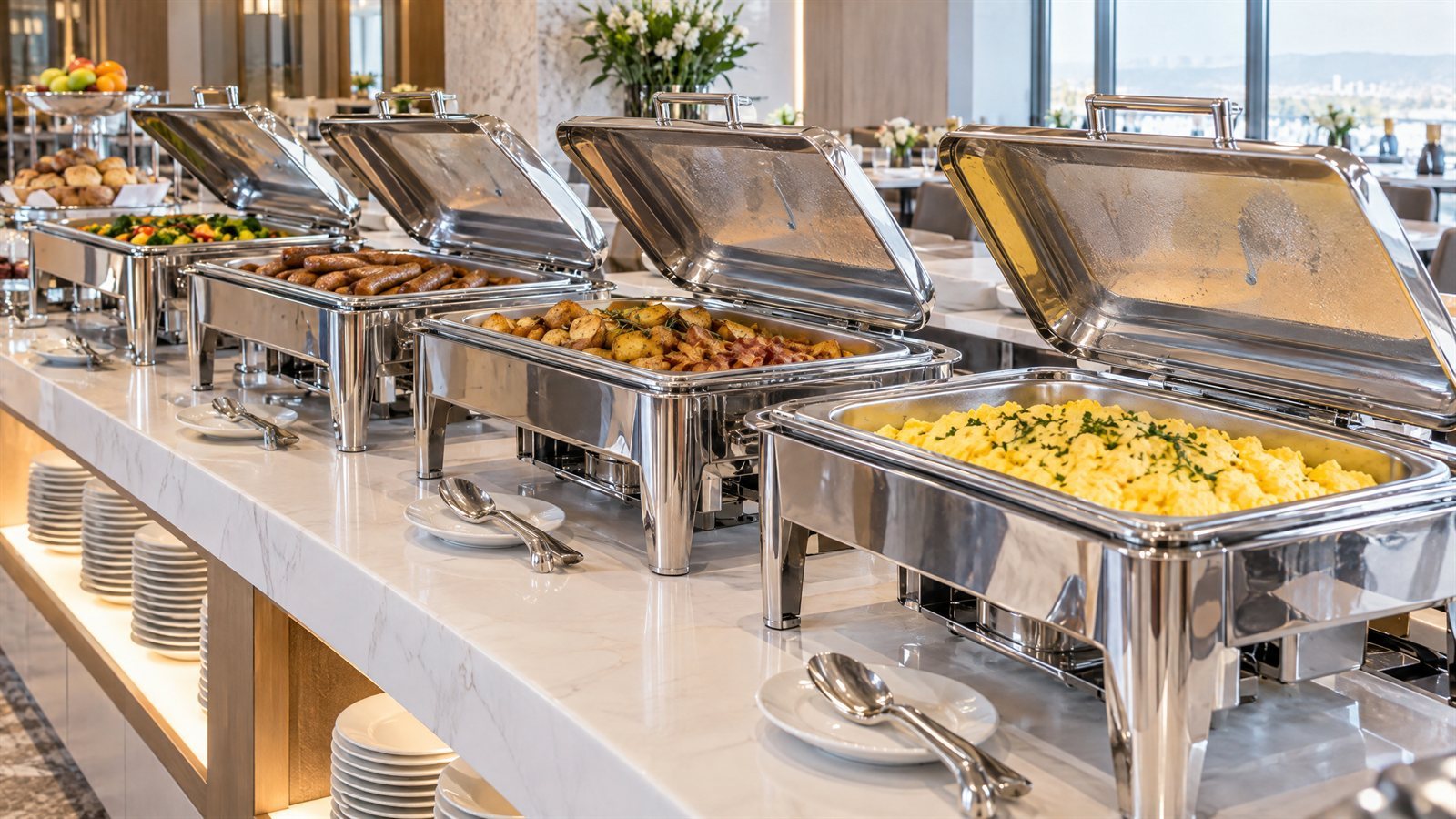
Hotels and caterers should compare four groups of specifications before selecting a chafing dish: the pan format, the actual capacity, the operating dimensions, and the service requirements. These factors determine whether a product will work in a breakfast buffet, banquet hall, outdoor event, restaurant line, or catering delivery program.
Pan format comes first
The food pan determines how ingredients fit inside the unit and how easily the kitchen can transfer food from preparation to service. A full-size chafing dish commonly accommodates a full-size food pan, while smaller units may use half-size, divided, or compact pans. Always confirm the exact pan dimensions supplied with the unit. Similar product names can refer to different internal layouts.
Capacity is more than the nominal volume
A product may be marketed as a 4-quart chafing dish or a large chafing dish, but the practical serving volume depends on the pan depth, the safe fill line, food type, and the amount of space needed for utensils. Liquid foods, rice, pasta, and foods with sauces should not necessarily be filled to the same level.
For purchasing decisions, separate nominal capacity from usable service capacity. Nominal capacity describes the container volume. Usable service capacity describes how much food can be served efficiently without overfilling, spilling, or making portioning difficult.
External dimensions affect buffet layout
Measure the complete footprint, including handles, hinges, lid movement, fuel holders, electric connections, and clearance for staff. Two products with similar pan sizes may need different table space because their frames and lid designs are different.
Service conditions change the best size
A hotel breakfast buffet may need a higher-capacity format because the dish remains in service for several hours. A catered cocktail event may benefit from smaller chafing tray sizes because the menu contains more dishes and the serving window is shorter. Outdoor events also require attention to wind protection, lid stability, fuel safety, and transport packaging. Catering teams planning a wedding reception can also review the wedding buffet setup equipment checklist for catering companies when they build the full service plan.
How to Choose the Right Chafing Dishes for Hotels and Caterers
The best chafing dish size is the one that supports the menu, guest volume, staffing plan, and available buffet space. Use the following process to compare options systematically.
1. Estimate the food volume required at peak service
Start with the number of guests expected during the busiest service period. Then estimate the portion size and the number of refills that the team can complete without disrupting service. A simple planning model is:
Required service volume = peak guests × average portion size × menu allocation ÷ expected refill cycles
This is a planning estimate rather than a fixed catering formula. Rice, pasta, vegetables, proteins, sauces, and desserts have different portion patterns. Buyers should validate the estimate against previous events or kitchen production data.
2. Match the pan size to the menu
Use larger pans for high-volume main dishes and foods that need stable holding time. Choose smaller or divided pans for sauces, toppings, vegetables, side dishes, desserts, or menus that require more variety on the buffet line.
A divided pan can improve menu flexibility, but it may reduce the volume available for each individual food. Confirm whether the divider is removable and whether replacement pans are available.
3. Check buffet footprint before checking the final quantity
Map the available table length and depth. Include space for plates, serving utensils, labels, beverages, and staff movement. A large number of full-size chafing dishes may provide adequate capacity but create congestion. In some layouts, combining full-size and smaller chafing dish sizes produces better traffic flow than using one format for every dish. Where table length is limited, the guide to a restaurant buffet table for space optimization shows how layout choices reduce congestion on the serving line.
4. Consider refill frequency and labor
A smaller unit can be economical when the kitchen is close to the service area and staff can refill frequently. A larger unit may be more efficient when the buffet is remote, the event is long, or labor is limited. The correct comparison is not only unit price. It is the combined cost of product, food waste, labor, transport, cleaning, and replacement pans.
5. Confirm the heating method
Chafing dishes may use fuel, induction, electric heating, or another heating arrangement. The heating method affects the operating setup and may change the required clearance beneath the pan. Ask the supplier for compatible fuel holders, heating elements, power requirements, temperature-control information, and operating instructions.
6. Verify the product for the intended environment
For hotels, the priorities may include appearance, repeat daily use, stacking, easy cleaning, and replacement-part availability. For caterers, the priorities may include transport weight, nesting, packaging, lid security, and resistance to frequent setup and breakdown. For outdoor service, wind and weather conditions should be included in the product evaluation. Hotels that are building a complete serving line can compare equipment families in the complete buffet equipment list for 5-star hotels.
Full Size Chafing Dish and Chafing Dish Dimensions: Specs, Materials and Lead Time
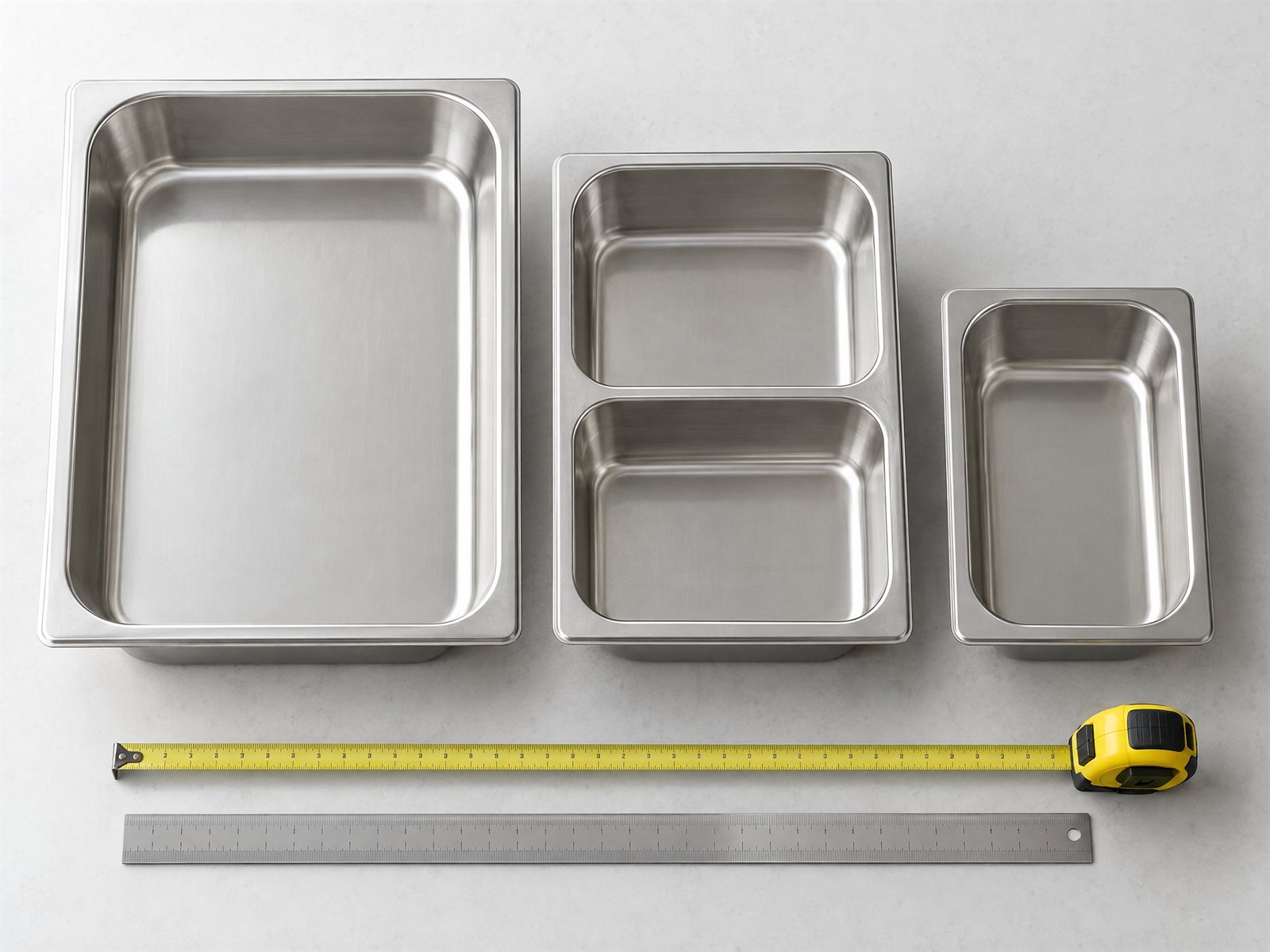
A full size chafing dish is generally selected for a standard full-size food pan and high-volume buffet service. However, “full size” is not a universal external measurement. Suppliers can use different frame designs, lid mechanisms, pan depths, and heating systems. Request a technical drawing or dimensional specification before approving a purchase order.
Dimensions to request from the supplier
Ask for the following measurements in the same unit system used by your procurement team:
- Overall length, width, and height with the lid closed.
- Working height with the lid opened to its service position.
- Internal pan length, width, and depth.
- Pan capacity and recommended fill level.
- Clearance required for fuel holders, induction plates, or electrical components.
- Nesting or stacking dimensions for storage and transport.
- Product weight, carton dimensions, and gross shipping weight.
Materials and finish
Common material choices include stainless steel for the body, frame, lid, and food-contact components. The exact grade, thickness, surface finish, welding quality, hinge construction, and handle design should be confirmed in the specification rather than assumed from a product photograph.
A polished finish can support a formal banquet setting, while a brushed finish may make everyday marks less visible. The most suitable finish depends on the customer’s cleaning process, visual standards, and expected frequency of use.
Manufacturing and lead time
Lead time can change according to quantity, customization, sample approval, packaging requirements, production scheduling, and shipping method. Buyers should request a written quotation that separates sample timing, mass-production lead time, inspection timing, and estimated shipping time.
If the order requires a custom logo, special finish, private label, modified pan configuration, or export packaging, mention those requirements at the quotation stage. This reduces the risk of comparing an off-the-shelf lead time with a customized order.
Size Chafing Dish Checklist Before You Place a Bulk Order
Use this checklist before approving a chafing dish size for a hotel, catering company, restaurant group, distributor, or private-label program.
Product and pan verification
Confirm that the product name matches the actual pan format. Request a drawing showing the pan dimensions, depth, usable capacity, divider options, lid opening angle, and heating-system placement. If you are replacing an existing unit, compare the replacement pan with your current serving and storage workflow.
Quality and construction verification
Review the body material, food-contact material, thickness, welding, edge treatment, hinge movement, lid handle, fuel-holder stability, and surface finish. A sample is especially useful for checking sharp edges, wobble, alignment, polish consistency, and ease of cleaning.
Compliance documentation
Ask what product documentation is available for the destination market. Depending on the product configuration and destination, buyers may need material declarations, food-contact documentation, test reports, factory quality records, or other supporting files. Do not assume that a general compliance statement covers every component or market.
Packaging and logistics
Confirm individual packaging, master-carton dimensions, carton quantity, drop-test or protection requirements, pallet configuration, shipping marks, and replacement-part packaging. A well-designed product can still create avoidable cost if cartons are oversized or the lid and handles are inadequately protected.
Commercial terms
Request the minimum order quantity, sample policy, production lead time, payment terms, quotation validity, inspection options, warranty terms, and after-sales process. Compare these items together rather than selecting a supplier only by unit price.
Recommended pre-order document
For a bulk order, prepare one specification sheet containing the product code, chafing dish dimensions, pan format, capacity, material, finish, heating method, packaging, quantity, delivery destination, and required documentation. Ask the supplier to confirm every line in writing.
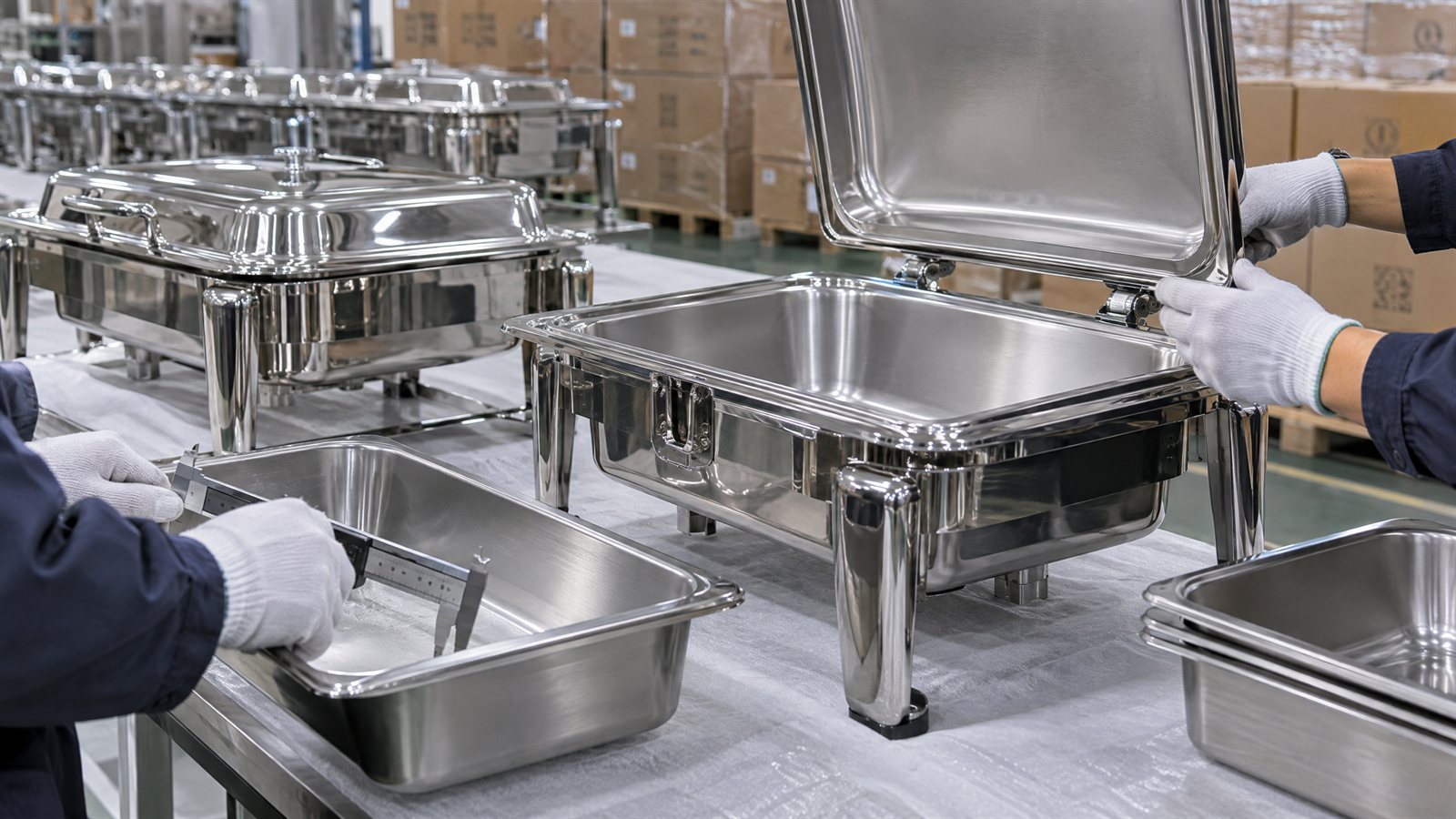
How PYEIN Tests Chafing Dishes Before Shipping
A reliable supplier should have a repeatable quality-control process that covers incoming materials, production, assembly, finished-product inspection, and packaging. The exact inspection plan should be agreed with the buyer because the most important checkpoints can differ between standard and customized products.
A practical pre-shipment inspection may include the following checks:
- Appearance and finish: Inspect polishing, brushing, color consistency, stains, dents, scratches, and surface defects.
- Dimensions: Measure key external and internal dimensions against the approved drawing or sample.
- Assembly: Check hinges, handles, frames, fuel holders, dividers, and moving parts for fit and function.
- Pan compatibility: Confirm that the supplied pan fits securely and that the lid closes and opens correctly.
- Stability: Check whether the assembled unit stands level and remains stable during normal handling.
- Packaging: Verify protective materials, carton labeling, quantity, accessories, and shipping marks.
PYEIN can discuss the inspection scope with buyers before production and align the inspection records with the approved product specification. This is particularly important when ordering a full size chafing dish, a customized finish, or multiple chafing tray sizes in one shipment.
Why PYEIN Is a Trusted Supplier of Chafing Dishes
Supplier selection should be based on more than a product catalog. Hotels and caterers need a partner that can translate a service requirement into a stable specification, communicate clearly during sampling and production, and support repeat orders with consistent quality.
PYEIN supports buyers by discussing product application, size selection, material and finish options, packaging, inspection, and delivery requirements. The purpose of this process is to reduce uncertainty before mass production begins.
For buyers comparing chafing dish sizes, the most useful supplier questions are practical:
- Can the supplier provide a detailed dimensional drawing?
- Can the supplier confirm the actual pan format and usable capacity?
- Can the supplier produce a sample before bulk production?
- Can the supplier support private label, packaging, or finish requirements?
- Can the supplier explain the quality-control process?
- Can the supplier provide the documents required for the destination market?
- Can the supplier maintain consistency across repeat orders?
PYEIN’s product team can help buyers compare the product configuration with the intended buffet layout and purchasing volume. Explore the chafing dish sizes and product range to review available options and begin a specification discussion.
Frequently Asked Questions About Chafing Dish Sizes
What is the difference between a full-size chafing dish and a 4-quart chafing dish?
A full-size chafing dish is typically designed around a larger standard food-pan format for higher-volume service. A chafing dish 4 quart model is more compact and may be suitable for side dishes, sauces, desserts, smaller buffets, or events that require more menu variety in a limited space. Always confirm the exact pan dimensions and usable capacity because naming conventions vary by supplier.
How do I choose between different chafing dish sizes for a hotel buffet?
Start with peak guest volume, service duration, menu type, refill labor, table dimensions, and storage space. Use larger formats for high-volume dishes and smaller formats for variety or lower-volume menu items. Then confirm the pan format, heating method, and complete operating footprint with the supplier.
Are chafing dish dimensions standardized?
Some food-pan formats are widely used across the foodservice industry, but the complete external dimensions of a chafing dish are not automatically identical between manufacturers. Frames, handles, lids, heating systems, and pan depths can change the footprint. Request a drawing before designing a buffet layout or approving a replacement order.
What are common chafing pan sizes?
Common options include full-size, half-size, divided, and compact pan configurations. The best choice depends on the menu and service volume. A chafing pan size should be compared using its length, width, depth, usable capacity, and compatibility with the chafing dish—not by the label alone.
How many servings does a chafing dish hold?
The answer depends on the pan capacity, food type, portion size, fill level, and refill plan. For purchasing, estimate peak service volume and validate the result using historical event data. Avoid treating a nominal capacity such as 4 quarts as a guaranteed number of servings.
What should I ask about NSF or FDA compliance?
Ask which specific components and documents are covered, what market the documentation applies to, and whether the food-contact materials are identified. Requirements vary by product configuration and destination. A supplier should explain the available documentation instead of providing an unexplained general claim.
Can I request a sample before placing a bulk order?
Yes. A sample can help you evaluate the finish, dimensions, pan fit, lid movement, stability, packaging, and compatibility with your buffet workflow. Share your intended application and required changes before sample production so the sample represents the specification you plan to order.
Request a Chafing Dish Sample and Quote from PYEIN
The right chafing dish size depends on your menu, guest volume, buffet footprint, service duration, and procurement requirements. If you are still comparing a full-size chafing dish, a compact unit, or a 4-quart configuration, send PYEIN your target pan format, estimated quantity, destination market, preferred material or finish, and required delivery window.
PYEIN can help you review suitable chafing dish dimensions, confirm available chafing pan sizes, arrange sample evaluation, and prepare a quotation for your project. Contact the PYEIN team to discuss your specification before placing a bulk order.
Request a free sample and quote for chafing dishes or download the buffet station product catalog to compare related buffet equipment.
Prefer to discuss your specification first? Contact PYEIN about chafing dish sizes and dimensions and share your buffet layout, guest volume, and delivery market.